Mastering Batch Process Control with the S88 Standard: A Deep Dive
In today’s competitive manufacturing landscape, efficiency, flexibility, and quality are more critical than ever. Batch processes—used in industries such as pharmaceuticals, food & beverage, and chemicals—often face challenges in standardization, integration, and scalability. That’s where the S88 Batch Control Standard comes in.
Formally known as ISA S88.01 or IEC 61512-1, this standard provides a universal framework for designing and managing batch processes. By introducing a set of models and terminology, S88 helps organizations streamline production, reduce engineering costs, and create systems that are modular, scalable, and vendor-neutral.
Whether you’re a process engineer, automation specialist, or plant manager, understanding S88 can offer transformative benefits. Let’s explore what this standard is all about, how it works, and why it matters.
Why S88? Solving Real-World Challenges in Batch Processing
Before the introduction of S88, batch control systems were largely custom-built, leading to inconsistent terminology, limited flexibility, and poor interoperability between equipment from different vendors. This lack of standardization made it difficult to:
- Convey production requirements clearly.
- Adapt systems to new products or processes.
- Integrate equipment or software from multiple suppliers.
S88 was developed to address these problems head-on. By providing a consistent structure and language for batch control, it simplifies communication, supports modular design, and enhances system integration across the entire production lifecycle.
Core Concepts and Terminology
At the heart of the S88 standard is clarity. It introduces clear definitions for batch-related terms to ensure everyone—from system designers to plant operators—is speaking the same language.
- Batch Process: A non-continuous, finite process that transforms input materials through a series of ordered steps using one or more pieces of equipment.
- Batch: The output material resulting from a single execution of a batch process. It represents a specific instance of production.
- Recipe: A structured set of information that defines the production requirements for a product, including the process steps, formulas, and equipment needs.
This terminology forms the foundation for the S88 models that guide how systems should be structured and operated.
The Four S88 Models Explained
To make batch processing more manageable and modular, S88 introduces four key models. Each model focuses on a different aspect of batch control, working together to form a cohesive structure.
1. Physical Model
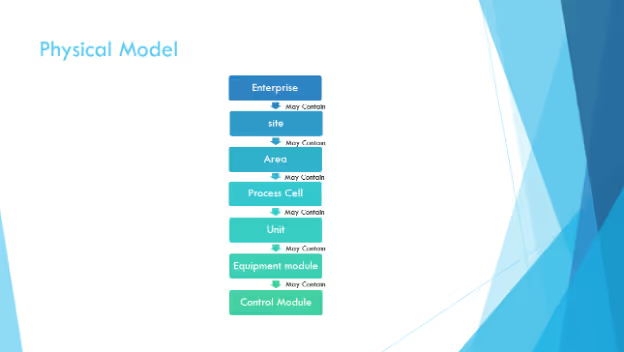
This model represents the hierarchy of equipment used in a batch plant, from the enterprise level down to individual sensors and actuators.
- Enterprise → Site → Area → Process Cell → Unit → Equipment Module → Control Module
Only the lower levels—starting from Process Cell—fall within the scope of batch control. For example, a Unit might include a mixing tank and heating system, while a Control Module could be a temperature sensor or valve.
2. Control Activity Model
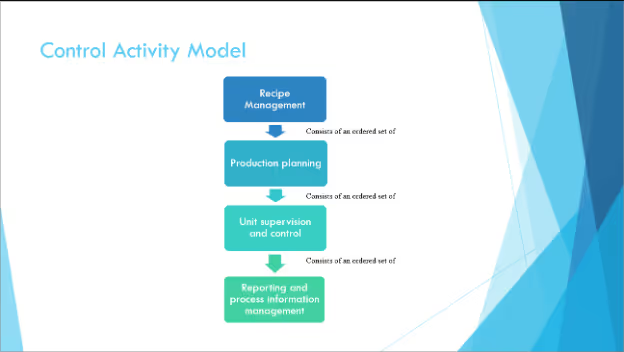
This model defines the relationships between various activities required to manage a batch operation, including:
- Recipe management
- Production planning
- Unit supervision and control
- Reporting and process information management
It ensures that all actions, from scheduling to execution, are coordinated and traceable.
3. Procedural Control Model
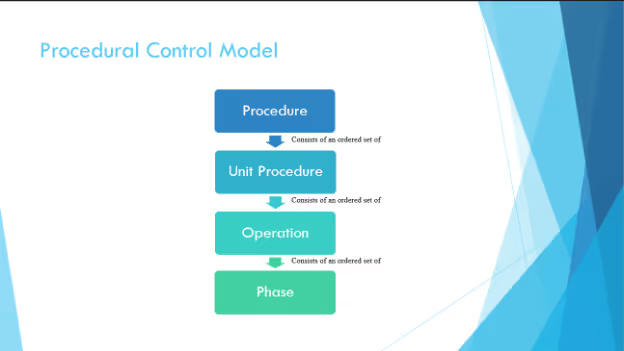
This hierarchical model breaks down the process execution steps into:
- Procedures (e.g., Make Product)
- Unit Procedures (e.g., Heat Solution)
- Operations (e.g., Add Ingredient)
- Phases (e.g., Open Valve, Start Mixer)
This model allows for precise control and automation of each process step, ensuring repeatability and safety.
4. Process Model
The Process Model mirrors the Procedural Control Model but focuses on the logical breakdown of the batch process itself, rather than how equipment executes it.
It includes:
- Process → Process Stages → Process Operations → Process Actions
This model is especially useful during the design and analysis of manufacturing processes.


Applying S88 in Real-World Scenarios
S88 is more than just a theory or a model—it has broad application in real world scenarios. Let’s say you’re managing a bioreactor used to produce a pharmaceutical compound. With S88, you can:
- Define standard recipes for various drug batches.
- Break down control strategies into manageable, reusable modules.
- Easily adapt the same recipe for different equipment at different sites.
This not only improves flexibility but also dramatically reduces development time for new products.
The Recipe Hierarchy: From Concept to Execution
Another powerful concept in S88 is the Recipe Model, which allows recipes to be defined and reused across multiple levels of the organization. There are four types of recipes:
- General Recipe: Equipment-agnostic and location-independent. Created at a corporate level.
- Site Recipe: Adapted to local site capabilities and constraints.
- Master Recipe: Tailored for specific process cells, including equipment-specific parameters.
- Control Recipe: Executed for a specific batch, with actual values and equipment path selected.
This structure makes it easier to standardize products across sites while accommodating local variability.
The Business Benefits of S88
Implementing the S88 standard isn’t just about technical rigor—it delivers measurable business results:
- 30% reduction in first-time project costs and development time.
- Up to 10% increase in plant throughput thanks to optimized control strategies and modular automation.
- Faster time-to-market for new products through reusable, scalable recipe and control structures.
- Improved system integration with reduced engineering effort and vendor lock-in.
In short, S88 enables agile manufacturing.
Final Thoughts: Why S88 is the Future of Batch Control
The ISA S88 standard fundamentally changes the way manufacturers approach batch processing. By clearly separating the product from the process used to make it, S88 provides unmatched flexibility in designing, scaling, and operating batch systems.
If you’re looking to build a future-proof manufacturing operation that is modular, efficient, and ready to adapt, adopting S88 principles is a smart move.
Whether you’re designing a new system or upgrading an existing one, applying S88 can help you stay competitive, reduce costs, and improve product consistency.
Skellig Automation’s engineers are subject matter experts in S88 application and would be happy to help you plan your next project. Contact us today at info@skellig.com to schedule a consultation!